Christine Edmonds
This article was originally published in Trowel Talk, the newsletter of the Master Gardeners of Ottawa-Carleton. It’s reproduced here with their permission and that of the author.
It is a sweltering day in late July. An erratically fluttering butterfly catches my eye. Or is it a moth? I recognize the flight pattern as uniquely skipper-like. Skipper is a good description for its fast-moving, bouncy flight. I follow it until it comes to rest on a blue-green Wild Blue Indigo leaf (Baptisia australis) by the edge of a path. I am intrigued because a few days ago a Wild Indigo Duskywing Skipper was nectaring on mountain mint (Pycnanthemum sp.) elsewhere in the garden. Is this a female Wild Indigo Duskywing? I lean in to take a photo, and upload it to iNaturalist and confirm her ID.
This skipper has not come for nectar. Wings open, she lays one milk coloured egg then darts off. It is a wonderous thing to be present at a birth. I lose sight of the mother skipper as I focus in on the egg.
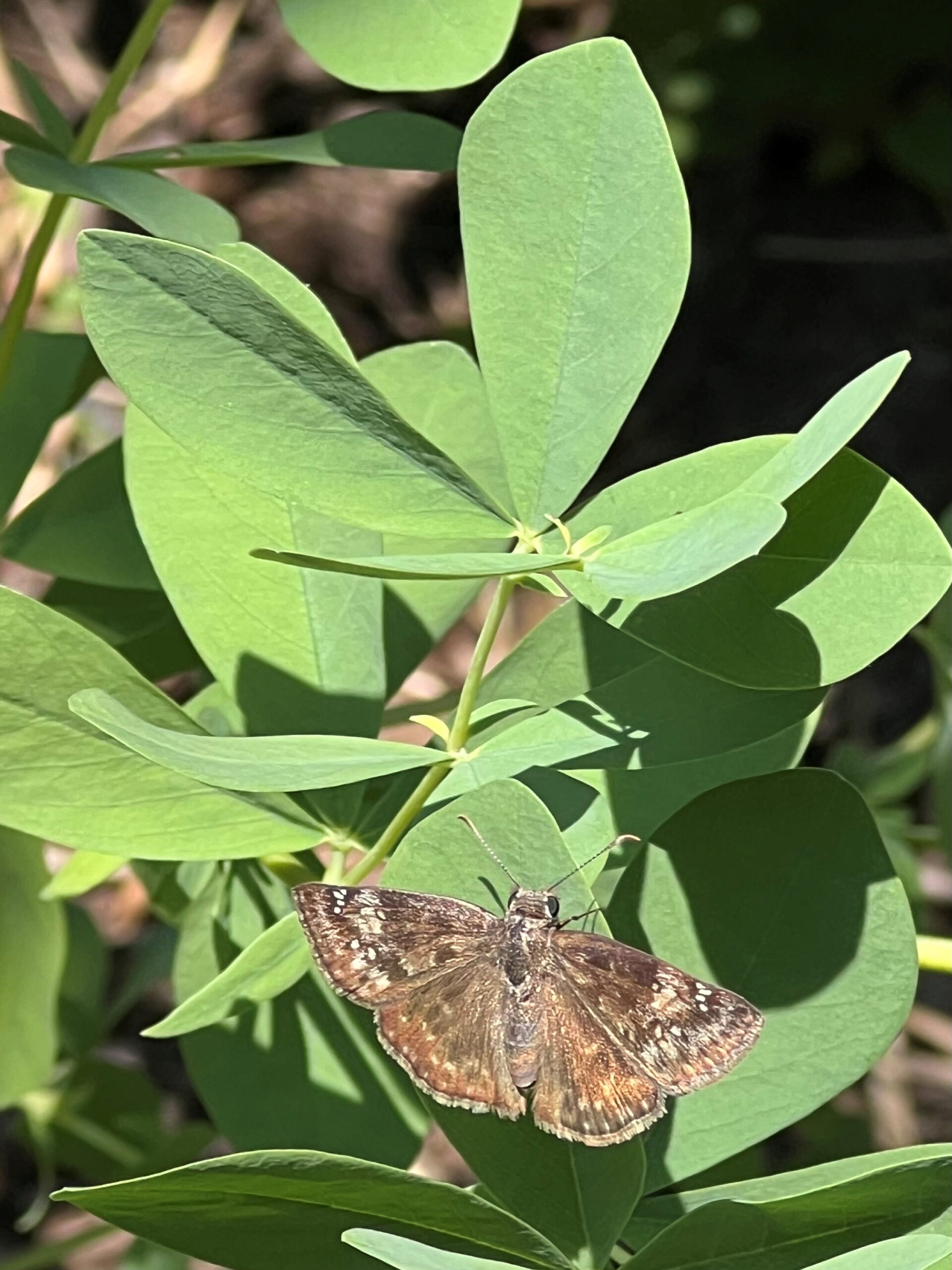 Female Wild Indigo Duskywing laying an egg on Wild Blue Indigo in late July. |
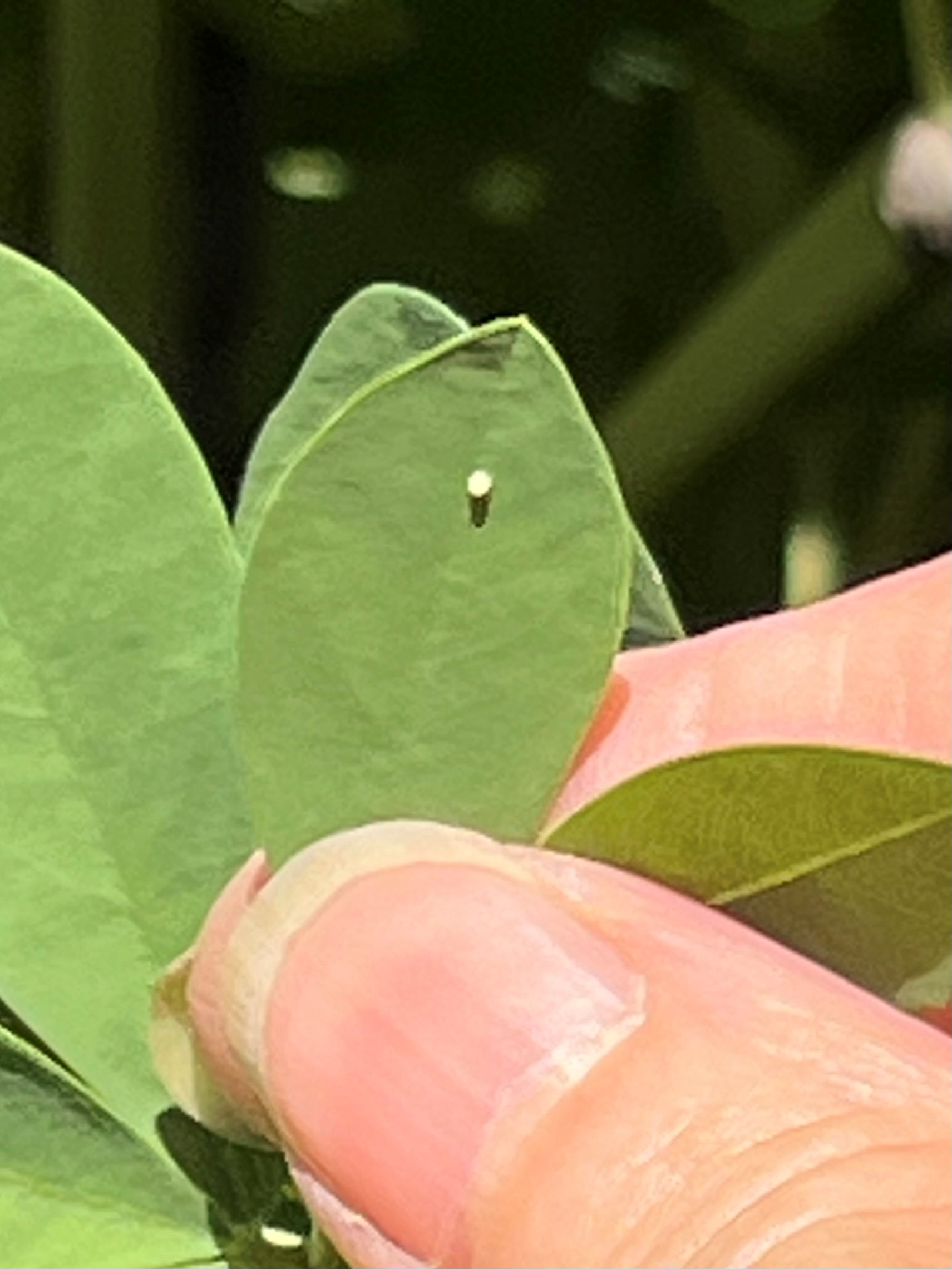 Duskywing egg on Wild Blue Indigo (Baptisia australis). |
Like all Lepidoptera, this mother has chosen a plant that her offspring is adapted to eat. The egg will hatch out into a larva, a caterpillar. The caterpillar will eat its way through leaves as it grows. This will not harm the plant, which is adapted to losing some foliage to these relationships. Just as Monarch butterfly larva are adapted to eat milkweed, Wild Indigo Duskywings are adapted to eat Wild Indigo and a few other plants such as Canada Milk Vetch (Astragalus canadensis). They are her host plants. B. australis is native to eastern North America and known to have good wildlife value. The Ontario native baptisia is Wild Yellow Indigo (B. tinctoria).
I know about butterflies and moths, but where do skippers fit in? Technically, they are butterflies. Like butterflies, adult skippers feed on flower nectar by day. However, their appearance is more like a moth. They are small, typically grey and orangish brown, with stout, hair-covered bodies. There are many different types, and they are hard to tell apart.
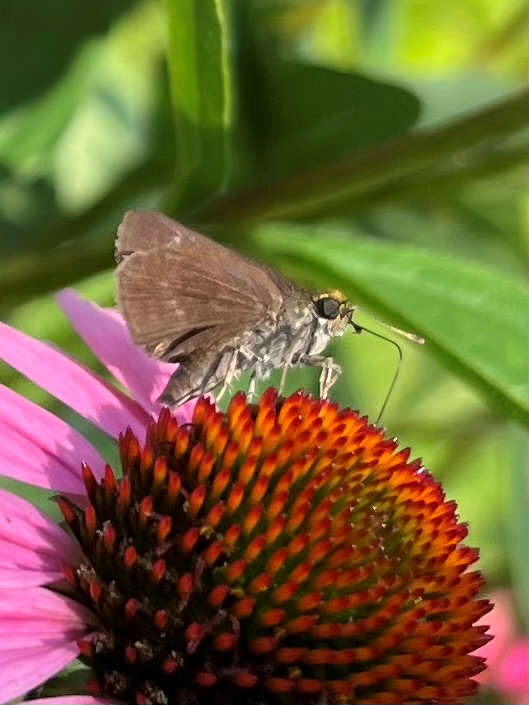
Dun Skipper nectaring on Purple Coneflower (Echinacea purpurea).
I am brought back to the present when another skipper flutters past. It lights on a nearby purple coneflower (Echinacea purpurea). This skipper is more purply brown than a Duskywing. I slip my phone from my pocket to take a picture – my only way of making a positive ID. It is a Dun Skipper. Unbothered by the photoshoot, it rolls out its proboscis to probe for nectar. Coneflowers are composite flowers made of colourful, sterile ray flowers (which have attracted the skipper) surrounding the central disc flowers. One by one it probes more discs for nectar in the flower’s ovaries.
Unlike Wild Indigo Duskywings, the name Dun Skipper does not hint at its host plant. Dun Skippers lay their eggs on species of sedges. Oak Sedge (Carex pensylvnaica) and Bristled-leaved Sedge (Carex eburnea) are some of its known host plants. Oak Sedge is a lovely ground-layer plant, adapted to dry shade. It spreads slowly and non-aggressively by rhizomes, mingling with woodland edge plants.
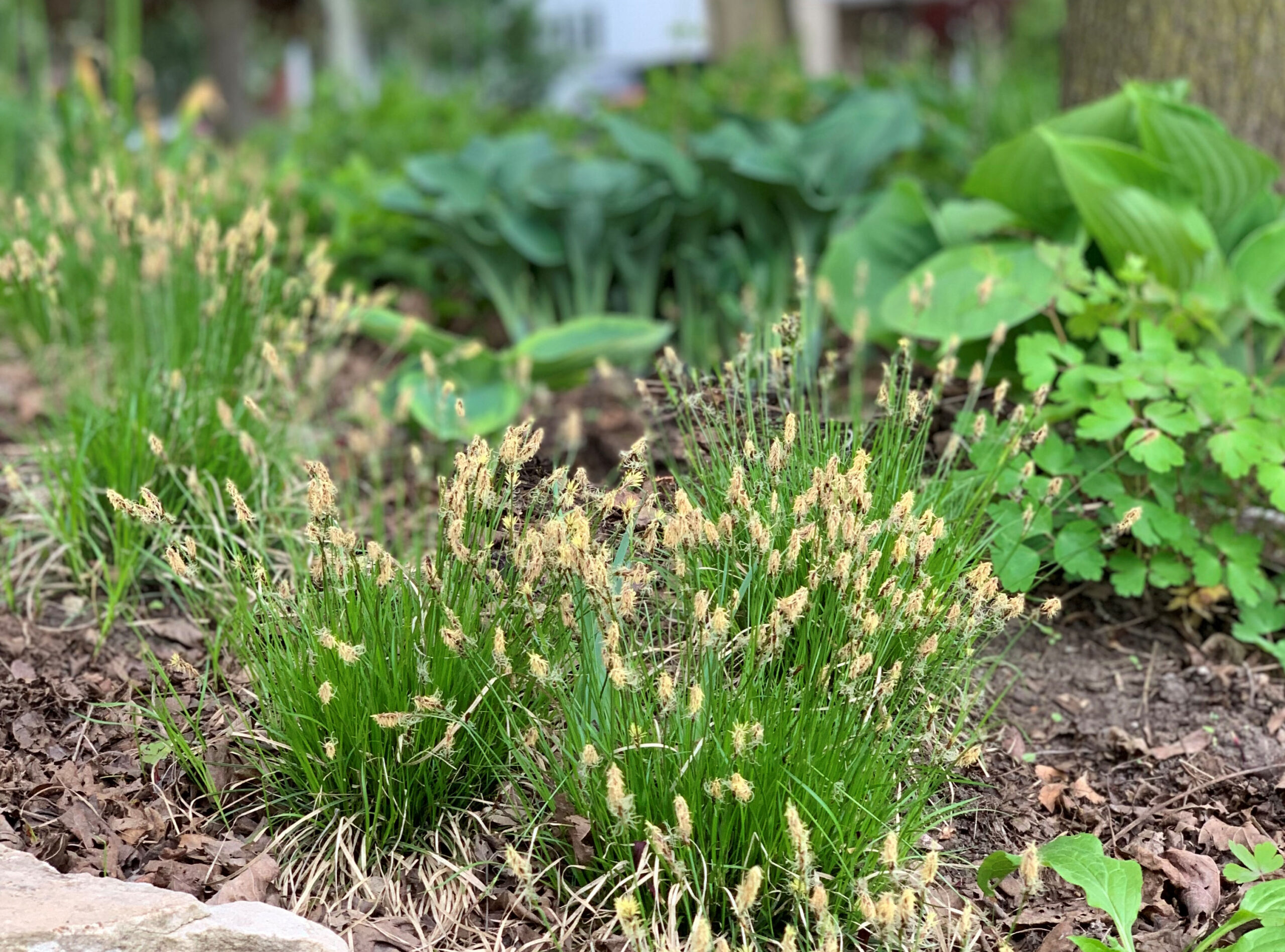
Oak Sedge (Carex pensylvanica), a larval host for Dun Skippers, flowering in early May.
Many songbirds feed their hatchlings the larvae of skippers, moths, and butterflies. Hence, plants that are larval hosts for Lepidoptera play an important part in supporting songbird populations. A well-thumbed copy of Lorraine Johnson’s A Garden for the Rusty-Patched Bumblebee sits on the bookcase beside my desk. I referred to her extensive lists of host plant relationships often as I planned the garden. Having ascertained that native sedges and grasses host a long list of butterflies, moths, and skippers, as well as providing nesting sites both for bees and birds, I planted lots of subspecies of each.
The darting, erratic flight pattern of skippers means that most sightings are brief and from a distance. I do not ID the majority of skippers I see. In years to come, I will satisfy my curiosity about what other kinds of skippers are out there by trying to get close enough to capture more photos. For today, it is enough to wonder if the caterpillars of Dun Skippers were on my Song Sparrow hatchlings’ menu in June.
Deprecated: File Theme without comments.php is deprecated since version 3.0.0 with no alternative available. Please include a comments.php template in your theme. in /home/wildpol/public_html/wp-includes/functions.php on line 6260